What is Point of View?
Point of View is the way that a writer chooses to show the reader their characters and their world. It is made up of many different components which must be considered carefully by the writer to achieve an effective narrative. These include grammatical person, tense, access, distance, reliability, and number of viewpoints.
Why is POV important?
Point of view controls what information the reader has access to and when, plot structure, suspense, and pacing. It allows the writer to dictate which characters are sympathetic or likable. Access to thought process and backstory have great effect on reader perception. Certain genres and time periods have different commonly used POVs. For instance, modern young adult novels use first person, present tense more often than adult novels.
Choosing your POV character
When selecting which character(s) will have a major POV consider:
- Which characters are at the center of your plot?
- Which characters need to give and receive information?
- Which characters are supposed to be sympathetic to the reader?
- Which characters do you want to write about?
Grammatical Person
Once you choose which character(s) need POVs, you need to make decisions about the major building blocks of those POVs. One of these building blocks is grammatical person. You will choose between first, second, and third person.
In first person (I), the narrator is a character in the story. First person provides intimacy, but limits access to information. You should choose a first person POV if you want to craft a narrative that includes constant inner dialogue, closeness with the character, or if you are writing in a category (like young adult) that uses first person often. (Note: All of these things can be accomplished through third person as well.)
Example: “I am dangling, and it is only my father’s blood-slicked grip around my wrist that stops me from falling. He is on his stomach, stretched out over the rocky ledge. His muscles are corded. Sticky red covers his face, his arms, his clothes, everything I can see. Yet I know he can pull me up. I do everything I can not to struggle. I trust him to save me.”
–The Will of the Many by James Islington
In second person (you), the reader is implicated in the narrative often resulting in an unsettling immersion. You should only choose second person in fiction if you are making a deliberate narrative choice to involve the reader in the story. In The Fifth Season, Jemisin uses second person to accuse the reader of the mistakes the protagonist has made.
Example: “’Something happened up north,’ Lerna tells you. You sit on the edge of the bed. He’s in a chair across from you. You’re drinking more nasty tea; your head hurts worse than a hangover.”
– The Fifth Season by NK Jemisin
Third person (he/she) is historically the most used grammatical person. The narrator stands outside of the action, providing less intimacy but greater access to information.
Example: “The straw is so warm that Damaya doesn’t want to come out of it. Like a blanket, she thinks through the bleariness of half-sleep; like the quilt her great-grandmother once sewed for her out of patches of uniform cloth.”
– The Fifth Season by NK Jemisin
Tense
Tense is the second major building block of POV. There are two choices for the primary tense of your story: present and past tense.
Writing in present tense means you can write your story like it’s currently happening. It creates immediacy and urgency and appears more commonly in modern fiction. While it can bring a reader closer to the action, some readers may feel alienated because they are not used to stories being told in this manner.
Example: “Sixty seconds. That’s how long we’re required to stand on our metal circles before the sound of a gong releases us. Step off before the minute is up, and land mines blow your legs off. Sixty seconds to take in the ring of tributes all equidistant from the Cornucopia, a giant golden horn shaped like a cone with a curved tail, the mouth of which is at least twenty feet high, spilling over with the things that will give us life here in the arena.”
– The Hunger Games by Suzanne Collins
Traditionally, past tense is the more common verb tense that is used in story-telling. This tense makes your narrative feel like it is a story being told to the reader and naturally invokes a fictional tone.
Example: “Mr Bennet was so odd a mixture of quick parts, sarcastic humour, reserve, and caprice, that the experience of three and twenty years had been insufficient to make his wife understand his character. Her mind was less difficult to develope. She was a woman of mean understanding, little information and uncertain temper. When she was discontented she fancied herself nervous. The business of her life was to get her daughters married; its solace was visiting and news.”
– Pride and Prejudice by Jane Austen
Note: This choice will change how you refer to things in the past. When using present tense, please use past tense to refer to things in the past. When using past tense, please us past perfect tense to refer to things in the past. This is one of the mistakes I see most often when reviewing work.
Access
Next, you need to decide how much access you reader has to the characters and world. You can do this by choosing between one of the three types of access:
An omniscient narrator knows everything including inner thoughts, events happening elsewhere, and–potentially–past or future events. It is used in modern fiction, but appears more commonly in classic literature.
Example: “Mr Bennet was so odd a mixture of quick parts, sarcastic humour, reserve, and caprice, that the experience of three and twenty years had been insufficient to make his wife understand his character. Her mind was less difficult to develope. She was a woman of mean understanding, little information and uncertain temper. When she was she fancied herself nervous. The business of her life was to get her daughters married; its solace was visiting and news.”
– Pride and Prejudice by Jane Austen
In a limited POV, the narrator’s information is restricted to the POV character. In close limited, the reader will know much of the character’s thought and feelings, while creating distance will obscure the innerworkings of the character.
Example: “Harry had never even imagined such a strange and splendid place. It was lit by thousands and thousands of candles which were floating in mid-air over four long tables, where the rest of the students were sitting
– Harry Potter and the Sorcerer’s Stone by JK Rowling
An objective narrator is used very rarely and usually as a vehicle for literary exploration. In this POV, the narrator only has access to what can be observed externally. This leaves little room for exploration of inner thought and feelings.
Example: “They sat down at the table and the girl looked across at the hills on the dry side of the valley and the man looked at her and at the table. ‘You’ve got to realize,’ he said, ‘that I don’t want you to do it if you don’t want to. I’m perfectly willing to go through with it if it means anything to you.’”
– Hills like White Elephants by Ernest Hemingway
Note: Multiple types of access can be used in one scene, but the line between sliding from omniscient POV to limited and head-hopping is very blurry. For new writers, choosing a distinct level of access and striving to maintain that throughout your work may yield better results.
Distance
The distance of your narrator describes how distinct your narrator is from your POV character.
Narration can be so close that the point of view character blends seamlessly with the thoughts and perception of the character. The closest POV is achieved by a close narrator combined with first person.
In a distant POV, the narrator is detached from the characters and observes events from outside the character’s thoughts and feelings. Objective access is the most distant.
Note: Access and distance are heavily reliant on one another, but distinct because access can be modified by distance to achieve different styles. For instance, third person and omniscient can be either close or distant. Distance is also on a sliding scale and can vary from scene to scene.
Reliability
Can your reader trust the information provided by your narrator?
If you answered “yes”, you are writing a reliable narrator. A reliable narrator generally recounts events accurately, though they may make some normal mistakes. Most fiction is written with a mostly reliable narrator.
Example: “Sixty seconds. That’s how long we’re required to stand on our metal circles before the sound of a gong releases us. Step off before the minute is up, and land mines blow your legs off. Sixty seconds to take in the ring of tributes all equidistant from the Cornucopia, a giant golden horn shaped like a cone with a curved tail, the mouth of which is at least twenty feet high, spilling over with the things that will give us life here in the arena.”
– The Hunger Games by Suzanne Collins
If you answered “no”, your narrator may have a warped, biased, mistaken, or deceptive account of the story which makes them unreliable. This can be used very effectively as a plot device to conceal information from the reader or mislead the reader.
Example: “True!—nervous—very, very dreadfully nervous I had been and am; but why will you say that I am mad? The disease had sharpened my senses—not destroyed—not dulled them. Above all was the sense of hearing acute. I heard all things in the heaven and in the earth. I heard many things in hell. How, then, am I mad? Hearken! and observe how healthily—how calmly I can tell you the whole story.“
–A Tell-Tale Heart by Edgar Allen Poe
Number of Viewpoints
How many viewpoints you choose to include in your narrative is largely dependent on story and genre. Some stories need multiple POVs to deliver the information necessary for the plot. Some stories only require one POV and are in fact more impactful because the whole narrative is restricted to one person’s feelings and opinions. For instance, the Harry Potter series would be less impactful if we got Voldemort’s POV because he would become a more sympathetic character making the reader root less for Harry.
The more POVs you include in your story, the more access to information you have and the more you can reveal your world to your reader. In a dual POV, you can switch between two characters to see both sides of a relationship or conflict. This can be particularly effective in romance novels.
In narratives that require multiple POVs, the reader can gain a deep sense of story and world-building, but balancing the different plotlines and character arcs can become challenging. Multiple POVs is most popular in adult fantasy novels with series like Malazan Book of the Fallen having over 450 unique POVs. This abundance of context creates a rich world where the author can choose anyone to provide color to the plot or setting.
Conversely, head-hopping is when the POV changes within a scene without clear delineation. In modern fiction, a scene break or chapter break is expected when changing between POVs, so if you intend to have multiple characters represented, make sure to root out all head-hopping from your work.
Note: If you are using more than one POV, pay attention to how compelling each POV is. Readers can easily form favoritism for reading different POVs which can create a discontented reading experience.
Breaking the Rules
Many celebrated authors have broken these rules altogether and have done so in ways that shift how we write today.
In Emma, Jane Austen blends her famous omniscient narrator with the characters’ POVs, moving back and forth with ease and without delineation. Georgia Elliot went on to do this more widely in Middlemarch.
In the quidditch match scene in Harry Potter and the Sorcerer’s Stone, JK Rowling moves between third person narration of Harry, Ron, and Hermione. She does the same in the troll scene later on: “Ron pulled out his own wand–not knowing what he was going to do he heard himself cry the first spell that came into his head: ‘Wingardium Leviosa’”
Note: JK Rowling only does this in the first book. All other narration from outside Harry’s POV is separated by chapters in later books.
Combining POV Elements
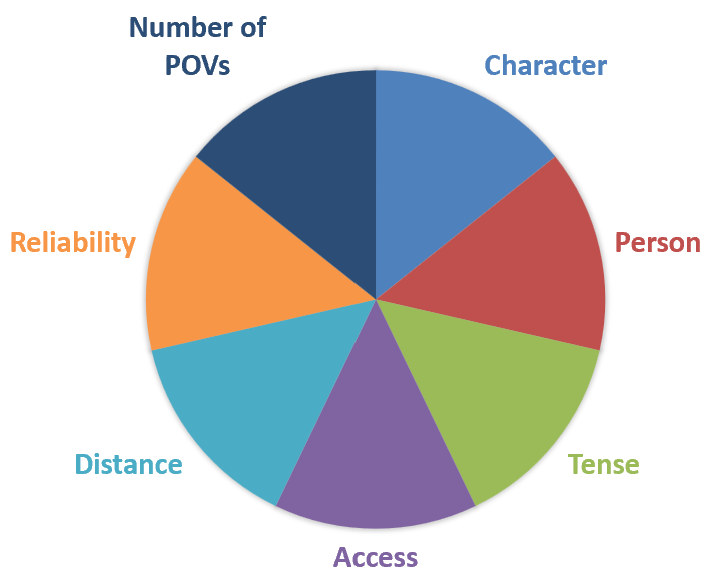
Consider your elements carefully as you move forward in your work. They can make or break your narrative.
Many authors change some or all of their POV choices once they have written enough to know how the narrative is best represented.
Examples of popular combinations:
-First person, present tense, limited, close, reliable
-Third person, present or past tense, limited, close, reliable
-Third person, past tense, omniscient, distant, reliable
Note: Having different grammatical person or tense points of view in one piece can be confusing for the reader or can enhance the narrative depending on the author’s skill-level and execution.
Using POV Effectively
Four examples of unique and effective use of POV:
Wolf Hall by Hilary Mantel
This novel uses close third-person from the POV of Thomas Cromwell to show us the famous court of King Henry VIII. Mantel rarely uses Thomas Cromwell’s name (despite it being third person) and constantly refers to Cromwell as “he” even in scenarios where the pronoun becomes ambiguous. She uses this method to immerse us in Cromwell’s mind since the character would never refer to himself by his own name in his thoughts.
The Fifth Season by NK Jemisin
In this sweeping fantasy novel, Jemisin creates a stunning plot twist using three points of view. Two are third person and the third is second person which lays blame at the reader’s feet for the mistakes the character has made. If you want to understand how to use POV as a plot device, read this novel because I won’t be spoiling it here.
We Ride Upon Sticks by Quan Barry
Like the Virgin Suicides, We Ride Upon Sticks uses the first person plural to represent a group of people. In this case, an entire field hockey team makes up the POV. This choice directly plays into the themes of the novel, namely complicity, group-think, and guilt.
Dracula by Bram Stoker
This classic novel stands outside the realm of traditional POVs since it is written entirely using ship logs, diary entries, and phonograph notes. There is no traditional narrator and therefore the tense, grammatical person, etc. are dependent upon the document being presented. Epistolary novels are still being published today, with The Correspondent being the most recent epistolary bestseller.
Writing your story
There are three steps I suggest that new writers take when choosing POV:
- Think about your favorite books and popular books in your genre. What are the prevailing choices? For instance, if you’re writing YA Fantasy, first person present tense is the most popular choice.
- Identify story elements that would be served by different POV combinations. For instance, if you need a character with a lot of interiority, choose first person. If you want to depict a wide world, choose many POVs.
- Consider how you want to write. If you hate writing in third person, don’t choose it just because you are writing an epic fantasy. Sometimes, it’s the norm-breaking that brings a narrative to life.
If you have any questions about how to build a compelling point of view, email me at BrieSuth@briesuth.com.






 Writing to keep Afloat
Leave a comment